
Breastfeeding, Tongue Ties, and the Missing Piece Many Parents Never Hear About

Few things are more discouraging than wanting to breastfeed your baby and feeling like no matter what you do, it just isn't working. Whether you're dealing with a baby who won't latch, painful breastfeeding, constant nursing, or concerns about tongue ties and feeding difficulties, there is hope.
Maybe you've met with lactation consultants. You've watched the videos. You've tried different positions. You've spent countless hours feeding, pumping, and worrying.
Yet your baby still seems hungry.
Feeds take forever.
Your nipples hurt.
Everyone keeps telling you something different.
And eventually you begin wondering if maybe breastfeeding just isn't going to work for you.
If that sounds familiar, you're not alone.
When parents experience breastfeeding difficulties, one of the first things they hear about today is tongue ties. In fact, tongue tie diagnoses have increased dramatically over the last two decades, and many families are now exploring procedures such as frenotomies and laser releases in hopes of improving feeding.
Sometimes these procedures can be incredibly helpful.
But they also raise an important question:
Why was feeding difficult in the first place?
Breastfeeding Is More Complex Than It Appears
From the outside, feeding looks simple.
Baby latches on and drinks milk.
But what appears simple is actually one of the most neurologically demanding tasks a newborn performs.
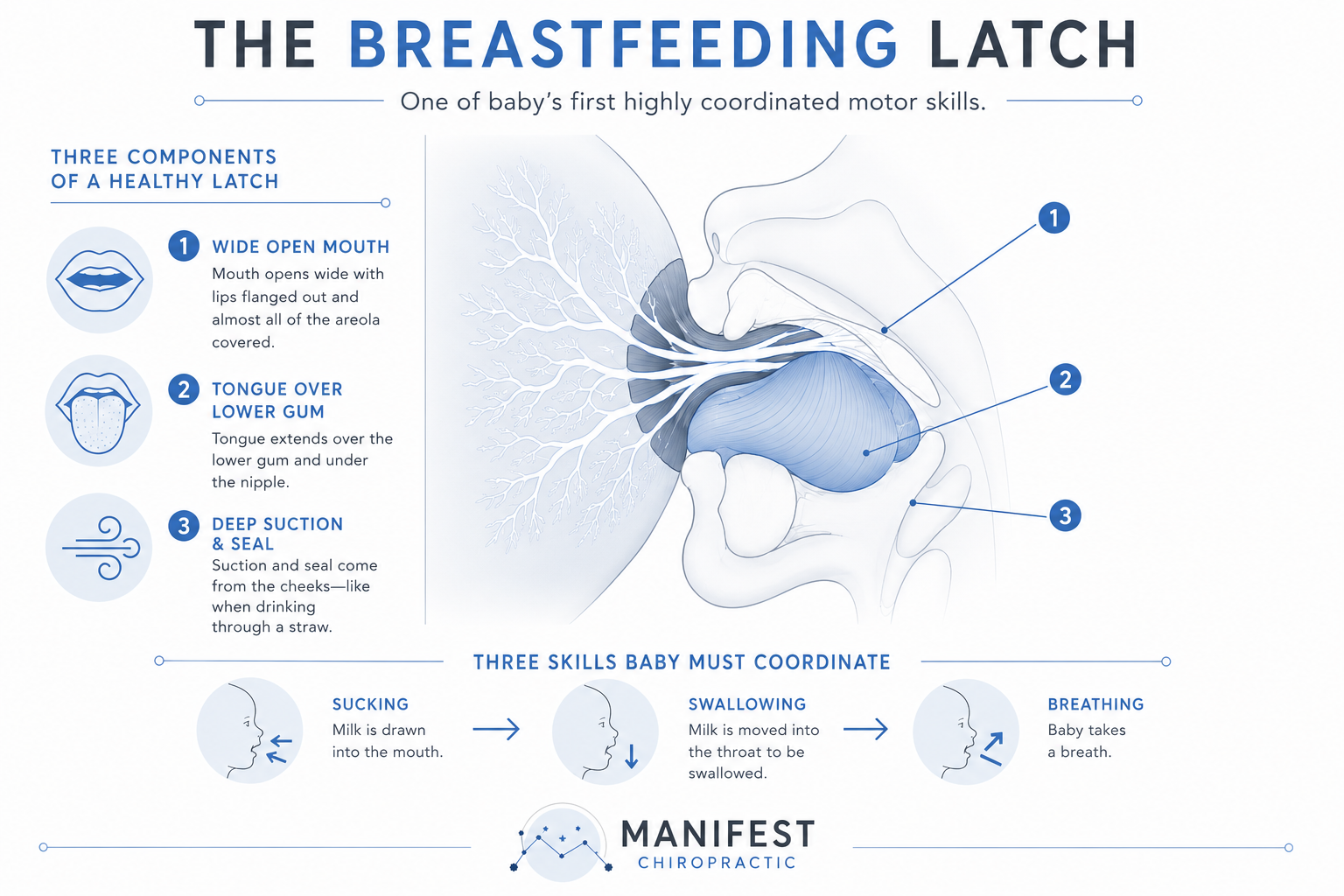
For feeding to happen successfully, a baby must coordinate sucking, swallowing, and breathing over and over again throughout every feeding session.
These actions cannot happen simultaneously. They must occur in a precise sequence that repeats hundreds, if not thousands, of times each day.
That requires an incredible amount of coordination from a nervous system that is only days or weeks old.
When that coordination is working well, feeding often appears effortless.
When it isn't, parents may begin noticing signs that something is off.
A baby may click while feeding, leak milk from the corners of the mouth, prefer one breast, struggle with reflux, feed for unusually long periods of time, or seem unsatisfied despite constant nursing.
For some families, feeding becomes one of the most stressful parts of the day.
Where Tongue Ties Enter the Conversation
When feeding difficulties arise, tongue ties are often one of the first explanations parents hear.
A tongue tie occurs when the tissue connecting the tongue to the floor of the mouth restricts normal tongue movement. Similarly, a lip tie may restrict movement of the upper lip. Common tongue tie symptoms may include difficulty latching, clicking during feeds, poor milk transfer, prolonged nursing sessions, maternal nipple pain, and concerns about weight gain.
Because the tongue plays such an important role in feeding, these restrictions can absolutely contribute to breastfeeding challenges.
This is why many providers recommend procedures that release restricted tissue.
The goal is straightforward: improve mobility and make feeding easier.
But while releasing tissue may improve movement, it doesn't necessarily explain why the tongue, jaw, lips, and oral structures were struggling to function optimally in the first place.
And that's where the conversation often stops.
The Nervous System's Role in Feeding
One factor that receives surprisingly little attention is the nervous system.
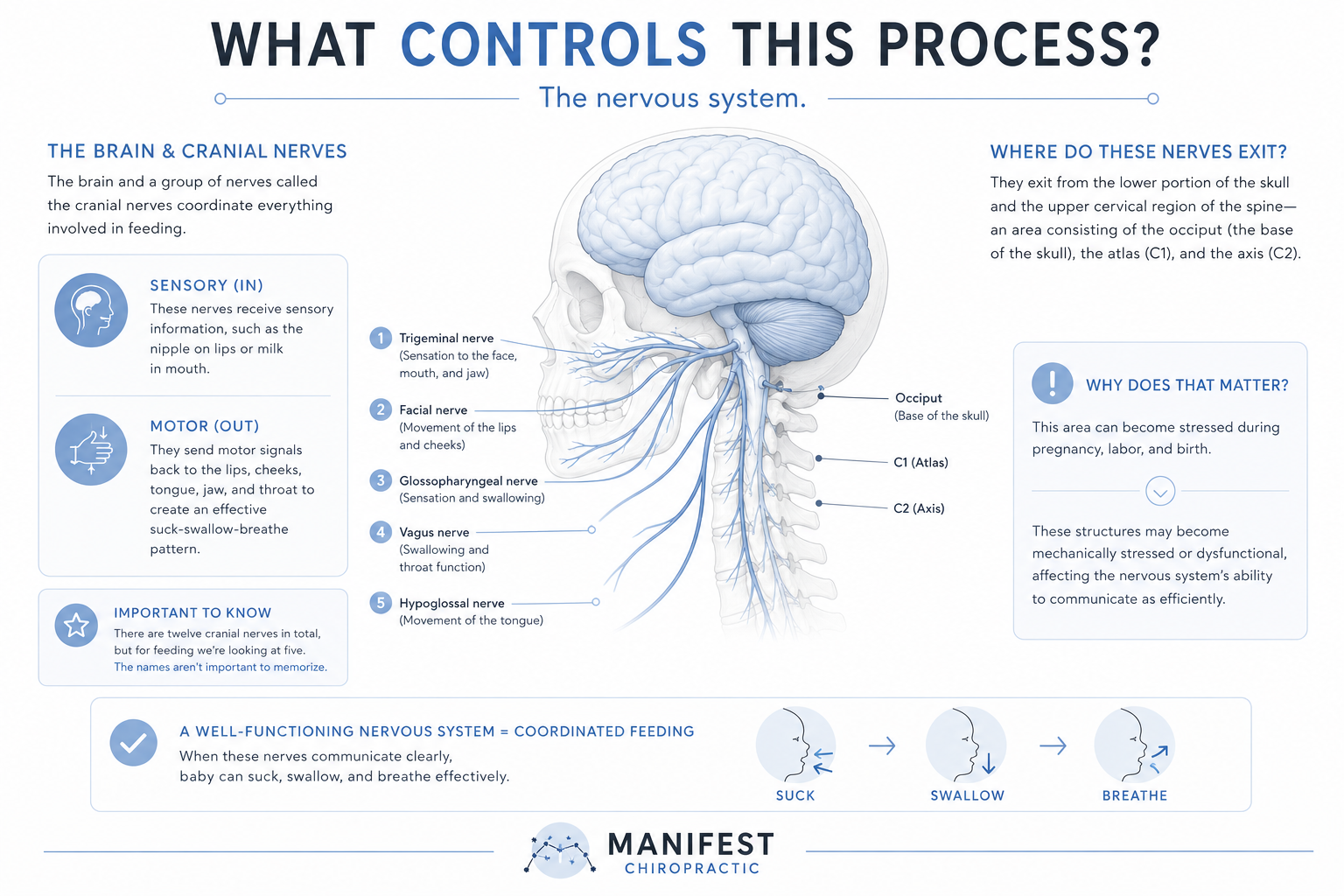
Every aspect of feeding is controlled by the brain and cranial nerves.
These nerves are responsible for gathering information from the mouth and coordinating the muscles of the lips, cheeks, tongue, jaw, and throat.
In other words, feeding is not simply a matter of anatomy.
It is a matter of communication.
The baby's body is constantly sending information to the brain, and the brain is constantly sending instructions back.
When communication is efficient, feeding tends to be efficient.
When communication becomes less efficient, coordination may suffer.
Why the Upper Neck Matters
The cranial nerves involved in feeding originate from areas associated with the brainstem and upper cervical region.
This includes the base of the skull, the atlas (C1), and the axis (C2).
These structures experience significant forces during pregnancy, labor, and delivery.
While birth is a natural process, it can also be physically demanding.
As chiropractors, this is one of the areas we pay close attention to because of its relationship to the nervous system.
If neurological stress is present in this region, it may influence how effectively the nervous system coordinates the many processes involved in feeding.
Feeding Is About More Than Movement
Most people understand that the nervous system controls movement.
What many people don't realize is that it also influences muscle tone and soft tissue tone throughout the body.
Think about what happens when you're stressed.
Your shoulders tighten.
Your jaw clenches.
Your neck becomes stiff.
You may even feel a lump in your throat.
Those changes occur because the nervous system influences how muscles and tissues behave.
Now consider a newborn.
A baby cannot tell us they feel tension in their jaw, tongue, throat, or neck.
But if the nervous system influences tissue tone throughout the rest of the body, is it possible that it could influence the tissues involved in feeding as well?
That is an important question worth considering.
What We Look For
When babies come into our office with feeding challenges, we are not simply looking at the mouth.
We are evaluating the nervous system.
Using a thorough Gonstead examination, including neurothermal instrumentation, palpation, and other objective findings, we assess for signs of neurological stress, particularly within the upper cervical region.
If those findings are present, we deliver a gentle and specific chiropractic adjustment designed to help reduce that stress.
Our goal is not to force a latch.
Our goal is not to directly treat a symptom.
Our goal is to help the nervous system function as efficiently as possible.
A Different Way to Think About Breastfeeding Challenges
When feeding difficulties arise, it's easy to assume the problem is simply milk supply, anatomy, or technique.
Those factors absolutely matter.
But sometimes there may be another piece of the puzzle.
Because feeding is ultimately a neurological process.
The nervous system coordinates sucking, swallowing, breathing, muscle tone, and movement patterns that all have to work together for feeding to feel effortless.
When that coordination improves, many families find that feeding becomes less stressful and more natural.
And for exhausted parents who feel like they've tried everything, that possibility can provide something incredibly valuable:
Hope.